
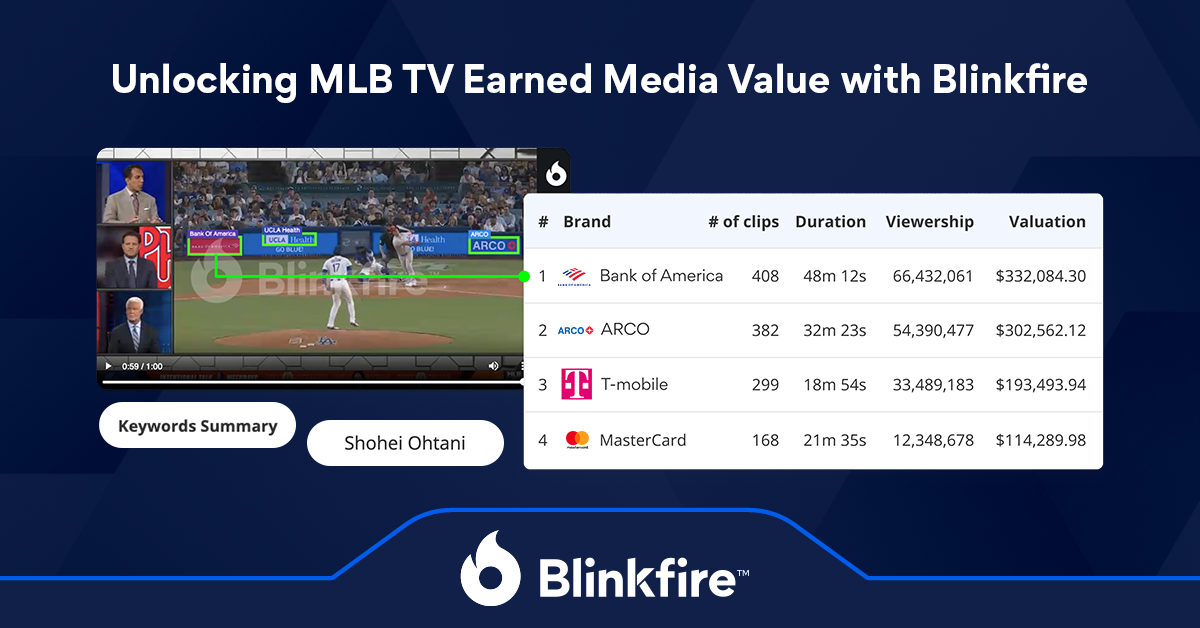
Major League Baseball is a content engine like no other. With 162 games per team, hundreds of broadcast hours, and endless news and highlight shows, the volume of TV earned media generated during the MLB season is staggering.
For brand partners and team commercial teams, this exposure represents millions of dollars in potential value. However, traditional post-campaign reporting, often delayed by weeks and reliant on manual clip reviews, leaves huge blind spots. Blinkfire captures every dollar of exposure, giving teams and brands accurate and actionable sponsorship data.
Audio Intelligence: Keyword Mentions & TV Transcripts
Visual exposure is only half the battle. Historically, tracking audio moments meant manual scrubbing of incomplete audio logs. With automated transcription engines built specifically for live television, every spoken word across TV Earned Media and MLB broadcasts is captured, timestamped, and rendered instantly searchable.
- Custom Keyword Triggers: Monitor verbal mentions for players, teams, stadium, and/or sponsored campaigns.
- Custom Metric Filtering: Filter earned media performance by specific date ranges, locations, assets, station, and/or individual brand assets.
- Instant Clip Generation: Search a transcript like a text document, jump straight to the exact timestamp, and automatically cut video clips with audio, no video editing software required.
Precise Brand & Asset Tracking
Logo placement on an MLB broadcast extends far beyond static outfield wall banners. From jersey sleeve patch partnerships to backstop wall, foul territory, and dugouts, branded assets are constantly moving across the screen. Our AI and computer-vision models analyze every frame of video in real time to detect and value brand exposures.
- Asset-Level Isolation: Dissecting value between specific physical placements. For example, distinguishing between a jersey patch exposure and a step-and-repeat during a post-game interview for the same brand.
- Clarity & Size Weighting: Our technology calculates exposure value based on logo size, on-screen duration, and clarity, rather than simple screen-time counters.

Real-Time Processing & Integrated Dashboards
The sports media cycle moves at lightspeed. A game-winning home run or a dramatic trade deadline move becomes a viral cultural moment within minutes. Waiting weeks for an agency to deliver a quarterly TV exposure report means missing the window to capitalize on real-time narrative trends. Blinkfire’s real-time processing ingests live TV feeds directly. This immediacy allows commercial teams to send real-time performance updates to key sponsor partners.
Sponsorship doesn’t happen in a vacuum. A jersey patch partner expects to see how their broadcast exposure connects with their social media presence and overall media reach. Integrated dashboards connect owned and earned TV, streaming, and social media into a unified interface.

Building Sponsorship ROI with Blinkfire
As MLB sponsorship inventory continues to evolve, from jersey sleeve patches to dynamic virtual signage, the tools used to measure their performance must keep pace. By combining Blinkfire’s computer vision and keyword intelligence, teams and brands can stop guessing their TV earned media impact and start proving their true ROI.
Written by
–
August 13, 2026
– 94 Views
PakarPBN
A Private Blog Network (PBN) is a collection of websites that are controlled by a single individual or organization and used primarily to build backlinks to a “money site” in order to influence its ranking in search engines such as Google. The core idea behind a PBN is based on the importance of backlinks in Google’s ranking algorithm. Since Google views backlinks as signals of authority and trust, some website owners attempt to artificially create these signals through a controlled network of sites.
In a typical PBN setup, the owner acquires expired or aged domains that already have existing authority, backlinks, and history. These domains are rebuilt with new content and hosted separately, often using different IP addresses, hosting providers, themes, and ownership details to make them appear unrelated. Within the content published on these sites, links are strategically placed that point to the main website the owner wants to rank higher. By doing this, the owner attempts to pass link equity (also known as “link juice”) from the PBN sites to the target website.
The purpose of a PBN is to give the impression that the target website is naturally earning links from multiple independent sources. If done effectively, this can temporarily improve keyword rankings, increase organic visibility, and drive more traffic from search results.
Jasa Backlink
Download Anime Batch